

Swiped right into a job: How dating apps became Gen Z’s networking hack
Sneha Kumari | Apr 14, 2026, 09:57 IST
Gen Z job seekers are turning to unconventional spaces like dating apps to find opportunities as AI-driven hiring filters out countless applications.

Image credit : ChatGPT AI Image | When applications disappear into algorithms, Gen Z stops waiting and starts finding opportunity in conversations no system can filter
Imagine this: a final-year college student in India, maybe in Pune, maybe in Hyderabad or in Gurugram. She's not "lost" or unprepared. In fact, she's done everything she was told to do. Good grades, a decent degree, internships on her resume, and even the kind of LinkedIn presence that feels slightly forced by necessity.
Now, she has applied to over 180 jobs. Tailored resumes, rewritten cover letters, and tweaked keywords, like her future depends on ATS algorithms (because it does). She has played the game exactly the way it's supposed to be played.
And yet, the game doesn't respond.
No calls, no feedback and just silence, broken occasionally by automated emails saying her application has been "received", as if that was the reassurance she was waiting for. So she takes a break the way most people do now.
She opens a dating app.
![ChatGPT AI Image | Gen Z rewrites the rules]()
Gen Z didn't suddenly decide to "hack" dating apps for careers. They adapted to a system that already stopped responding to them. Today's job market doesn't feel like rejection; it feels like absence.
You don't get a "no". You get silence plus an automated email that says, "We have received your application," like that's supposed to be comforting. Behind the scenes, most resumes never reach a human anyway.
They are filtered through AI systems scanning for keywords, formatting patterns and "fit signals" that nobody can fully explain. So you can be qualified and still be invisible.
That's the key shift: it's not just competitive anymore; it's non-human first.
![Pexels | The Only Place Left to Get a Job Might Not Be a Job Portal]()
A lot of students and early professionals have quietly moved away from "apply and hope" toward "connect and convert".
Not in a cynical way, in a survival way. But here's where it gets interesting: they are not only doing it on LinkedIn. Because LinkedIn, for many Gen Z users, feels like walking into a room where everyone is already mid-pitch.
Every message sounds rehearsed. Every post sounds like it was approved by a personal branding coach. Even "casual" networking DMs feel like they come with a hidden invoice attached.
So people started shifting where real conversations happen. Group chats, discord servers, Instagram mutuals and even gaming communities.
And yes, dating apps.
Not because they are "turning dating into LinkedIn", but because those are some of the few places where conversations don't start with a resume.
![Pexels | Why Gen Z Is Ditching Job Portals for Something Far More Human]()
Here's the twist: dating apps are structurally good at one thing professional platforms are bad at, reducing performance pressure. On a dating app, nobody opens with "Let me tell you about my five-year career plan."
They open with memes. Casual banter and random observations at 1AM. That lowers the guard. And when people are less guarded, they share more honestly, including when they do what they want and they are curious about.
So when someone says, "Oh, you work in product design? I’ve been trying to break into that; it doesn’t feel like a cold pitch. It feels like a conversation.
That's the real reason it works. Not manipulation, just context.
In India, this trend hits a slightly different nerve.
Professional networking has always been relationship-driven here: referrals, alumni links, and internal introductions. Everyone knows "who you know matters", even if nobody says it out loud in official career advice.
What’s changed is where those “who you know” connections are now forming.
But dating apps in India still carry social stigma in many circles. They’re not neutral platforms. They’re still loaded with assumptions, judgement, and privacy concerns, especially for women.
And that creates a strange tension; you are using a space designed for romance, for something strategic, while also managing safety, perception and boundaries. So even when this kind of networking happens, it's usually subtle, careful and heavily controlled.
Nothing about it is casual in the way it looks from the outside.
![Pexels | The New Rules of Job Hunting for Gen Z]()
Most of them aren't romanticising it. They are not sitting there thinking, "Wow, love is the new LinkedIn."
They are thinking something much simpler: "If I can’t get seen in the system, I’ll find a way around it. " And that includes DMs instead of cold emails, communities, conversations instead of applications and sometimes, yes, apps that were never meant for hiring at all.
Honestly? That question belongs to an older internet. For Gen Z, the more relevant question is, "Did it lead to a real human conversation that the system never gave me?"
If yes, they don't really care what you call it. Because in a world where applications disappear into algorithms, the real currency isn't formality anymore.
It's access.
Now, she has applied to over 180 jobs. Tailored resumes, rewritten cover letters, and tweaked keywords, like her future depends on ATS algorithms (because it does). She has played the game exactly the way it's supposed to be played.
And yet, the game doesn't respond.
No calls, no feedback and just silence, broken occasionally by automated emails saying her application has been "received", as if that was the reassurance she was waiting for. So she takes a break the way most people do now.
She opens a dating app.
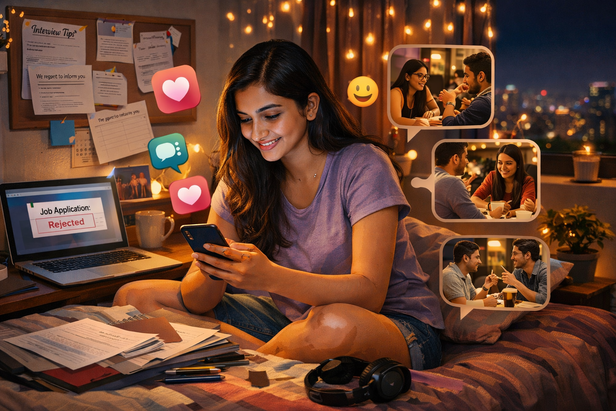
Image credit : ChatGPT AI Image | Gen Z rewrites the rules
The job hunt isn't broken; it's filtered
You don't get a "no". You get silence plus an automated email that says, "We have received your application," like that's supposed to be comforting. Behind the scenes, most resumes never reach a human anyway.
They are filtered through AI systems scanning for keywords, formatting patterns and "fit signals" that nobody can fully explain. So you can be qualified and still be invisible.
That's the key shift: it's not just competitive anymore; it's non-human first.

Image credit : Pexels | The Only Place Left to Get a Job Might Not Be a Job Portal
So people stopped waiting for permission
Not in a cynical way, in a survival way. But here's where it gets interesting: they are not only doing it on LinkedIn. Because LinkedIn, for many Gen Z users, feels like walking into a room where everyone is already mid-pitch.
Every message sounds rehearsed. Every post sounds like it was approved by a personal branding coach. Even "casual" networking DMs feel like they come with a hidden invoice attached.
So people started shifting where real conversations happen. Group chats, discord servers, Instagram mutuals and even gaming communities.
And yes, dating apps.
Not because they are "turning dating into LinkedIn", but because those are some of the few places where conversations don't start with a resume.

Image credit : Pexels | Why Gen Z Is Ditching Job Portals for Something Far More Human
Why dating apps accidentally became networking spaces
They open with memes. Casual banter and random observations at 1AM. That lowers the guard. And when people are less guarded, they share more honestly, including when they do what they want and they are curious about.
So when someone says, "Oh, you work in product design? I’ve been trying to break into that; it doesn’t feel like a cold pitch. It feels like a conversation.
That's the real reason it works. Not manipulation, just context.
India makes this even more complicated
Professional networking has always been relationship-driven here: referrals, alumni links, and internal introductions. Everyone knows "who you know matters", even if nobody says it out loud in official career advice.
What’s changed is where those “who you know” connections are now forming.
But dating apps in India still carry social stigma in many circles. They’re not neutral platforms. They’re still loaded with assumptions, judgement, and privacy concerns, especially for women.
And that creates a strange tension; you are using a space designed for romance, for something strategic, while also managing safety, perception and boundaries. So even when this kind of networking happens, it's usually subtle, careful and heavily controlled.
Nothing about it is casual in the way it looks from the outside.

Image credit : Pexels | The New Rules of Job Hunting for Gen Z
So what does Gen Z actually believe about this?
They are thinking something much simpler: "If I can’t get seen in the system, I’ll find a way around it. " And that includes DMs instead of cold emails, communities, conversations instead of applications and sometimes, yes, apps that were never meant for hiring at all.
So...was it a date or networking?
If yes, they don't really care what you call it. Because in a world where applications disappear into algorithms, the real currency isn't formality anymore.
It's access.

Elon Musk backs ‘free money’ as AI threatens jobs
By Nancy Jaiswal

Trump hints at Pakistan visit if Iran deal is signed
By Nancy Jaiswal

Elon Musk confirms more Tesla Diners expansion plan
By Nancy Jaiswal

The viral Savory Girl snack plate trend explained
By Saloni Jha

How Gen Z’s love language became a new vocabulary of flirting
By Saloni Jha

Who is Tesfaye Cooper? Facebook Live torture convict back in custody after brutal Chicago cyclist assault and robbery case
By Nillohit Bagchi

Virat Kohli's 'like' on influencer LizLaz's photo sparks reactions
By Karen Noronha


